How Much Electricity Does a Countertop Ice Maker Use?
A countertop ice maker's electricity use depends on its wattage and how long it runs. For a rough estimate, divide its watts by 1,000, then multiply by hours used and your electricity rate.
On this page (7 sections)
- How do you estimate countertop ice maker electricity use?
- What affects how much electricity an ice maker uses?
- How can you compare wattage across countertop ice makers?
- Does a countertop ice maker use power when you aren't taking ice?
- How can you reduce unnecessary electricity use?
- Is a countertop ice maker cheaper to run than buying bagged ice?
- What is the simplest way to estimate your cost?
A countertop ice maker's electricity use depends on its wattage and run time. For a rough estimate, divide watts by 1,000, multiply by the hours it runs, then multiply by your electricity rate to estimate cost.
The wattage label helps you compare models, but it isn't a direct monthly bill. Your actual use depends on how often you make ice, how long the machine runs, and whether it cycles or stays powered between batches.
How do you estimate countertop ice maker electricity use?
Multiply the machine's kilowatts by its operating hours to estimate energy use in kilowatt-hours (kWh). Then multiply that number by your cost per kWh to estimate the electricity cost.
For example, a 150-watt machine running for 5 hours uses about 0.75 kWh: 150 ÷ 1,000 × 5. At an electricity rate of 20 cents per kWh, that would cost about 15 cents for those 5 hours.
This is a simple estimate, not a measured result. A machine may cycle as it makes ice, and your home's electricity rate may vary by location, time, or plan.
What does the wattage number tell you?
Wattage is a measure of power, not a monthly energy total. To estimate energy use, you also need to know how long the machine runs.
A 100-watt ice maker running for 10 hours uses about the same energy as a 200-watt machine running for 5 hours, based on this simple calculation. That doesn't mean the machines produce the same amount of ice or run in the same way.
The U.S. Department of Energy explains kilowatt-hours and electricity use.
Use your utility bill's rate for the clearest estimate.
What affects how much electricity an ice maker uses?
Run time is the main factor you can control. The more hours the machine operates, the more energy it can use.
Your ice demand affects that schedule. A household that runs a machine for a short gathering will use it differently from one that runs it through the day to keep ice available.
Room conditions, setup, and maintenance may also affect how a machine operates. Follow the manufacturer's instructions for placement, cleaning, and use, and don't assume a daily ice-production figure tells you the electricity required to make that amount.
How can you compare wattage across countertop ice makers?
Compare wattage alongside the hours you expect to run each machine. A lower wattage alone doesn't guarantee a lower bill if that machine runs much longer.
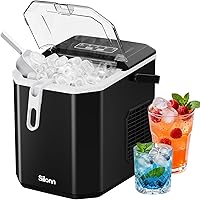
The Silonn Portable Bullet Ice Maker with Carry Handle is rated at 160 watts and makes bullet-shaped ice. Its carry handle and 8.7 × 11.4 × 11.6 in dimensions may suit readers who want to move a machine between rooms.
The Euhomy 44 lb Nugget Ice Maker is rated at 135 watts and makes nugget ice. Its 44 lb daily production capacity may fit a household that expects to use more ice, though capacity alone doesn't predict energy use.
The Frigidaire 26 lb Black Stainless Bullet Ice Maker is rated at 1,000 watts. That higher stated wattage makes run time especially important to consider in your estimate.
Actual use depends on operation and conditions. Compare expected run time as well as wattage when estimating energy use.
Does a countertop ice maker use power when you aren't taking ice?
It can use power while it remains on, even if you're not actively taking ice. The exact behavior depends on the machine and its controls.
If you only need ice for a meal or event, consider switching the machine off when you've made enough. Check its manual for the right way to stop, drain, and store it.
The guide to using a countertop ice maker covers setup and operation. For ongoing care, see how to clean a countertop ice maker.
How can you reduce unnecessary electricity use?
Run the machine when you need ice, then turn it off when you're done. This avoids operating it just to keep making ice you won't use.
Clean and maintain it as directed, and follow its placement instructions. Don't block openings or improvise a setup that conflicts with the manual.
Think about your routine before choosing a model. Our guide to countertop ice maker basics and buying can help you compare styles and features, while the best ice makers for home covers options for different household needs.
Is a countertop ice maker cheaper to run than buying bagged ice?
The answer depends on your electricity rate, how much ice you use, and the machine's run time. Include the cost of the machine and any other ongoing costs in a full comparison.
To estimate electricity cost, calculate kWh for the hours you run the machine and multiply by your rate. Compare that estimate with what you currently spend on ice over the same period, using the same amount of ice.
A countertop machine may be useful for convenience even if the cost comparison is close. If you're deciding how long a machine might fit your routine, read how long countertop ice makers last.
What is the simplest way to estimate your cost?
Use the machine's wattage, your estimated hours of operation, and your electricity rate. Lower run time generally means lower electricity use, while wattage helps you understand how quickly energy use adds up during those hours.
Choose a bullet model if its ice style and expected output fit your routine; consider a nugget model if you want chewable ice. Compare each one's wattage and expected schedule, then use the same calculation to estimate cost.
For setup and daily operation, start with how to use a countertop ice maker.
Frequently asked questions
How much electricity does a countertop ice maker use?
It depends on the machine's wattage and how long it runs. Estimate kilowatt-hours by dividing watts by 1,000 and multiplying by operating hours.
To estimate cost, multiply that energy use by your electricity rate; actual use can vary with conditions and cycling.
Does a countertop ice maker use electricity when it is full?
It may use power while plugged in, even when the ice basket is full, depending on its controls and design. Check the manual for what the full-basket indicator does.
If you don't need more ice, switching the machine off and unplugging it avoids leaving it powered.
Is a nugget ice maker more expensive to run than a bullet ice maker?
You can't tell from ice style alone. Compare each machine's wattage and the hours it runs, then use the same electricity rate for both estimates.
A machine that makes more ice may run longer if you use that capacity, so your schedule matters too.
How can I reduce a countertop ice maker's electricity use?
Make ice only when you need it, switch the machine off when you're done, and avoid running it to maintain a full basket. Keep it clean and follow its setup and ventilation instructions.
These steps reduce unnecessary run time, though the savings depend on the machine and your use.