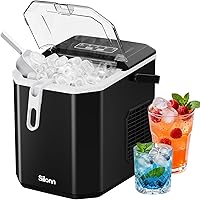
What Size Ice Maker Do I Need?
Match daily output to your busiest day, not your average one: about 25 to 30 lb suits two or three people, and 35 to 45 lb covers four or more or regular guests. Then confirm the basket size, water tank and counter footprint fit how you actually serve ice.
On this page (10 sections)
- What size ice maker do I need for my household?
- Why does daily ice output matter more than storage?
- How big is the ice basket, and when does it matter?
- How much water tank capacity is enough?
- How much counter space does a countertop ice maker take up?
- Which ice style fits your household best?
- Does ice type or machine size change the electricity bill?
- Do countertop ice makers keep ice frozen?
- How should you measure your space before buying?
- Which countertop ice maker size should you pick?
The countertop ice maker size you need depends on how much ice your household uses on its busiest day. As a rule, about 25 to 30 lb of daily output suits two or three people, while 35 to 45 lb covers four or more people and regular guests.
That figure is the starting point, not the whole decision. A machine that makes plenty of ice but holds a small basket, or one that is too wide for your counter, will still frustrate you.
This guide walks through daily output, storage capacity, water tanks, counter space and power draw, so you can pick a size with confidence. By the end you'll know exactly what to look for.
What size ice maker do I need for my household?
Match daily output to the number of people who use ice most days, then add headroom for entertaining. A household of two rarely needs a 44 lb machine, while a family of five will empty a small one during a hot weekend.
Use these bands to narrow the field. Treat them as starting points, since how you use ice matters as much as headcount.
| People | Typical daily output | Handles |
|---|---|---|
| 1–2 | 25–30 lb | Daily drinks, occasional iced coffee |
| 3–4 | 35–40 lb | Family dinners, smoothies, a pitcher |
| 5+ | 40–45 lb | Regular hosting, coolers, big gatherings |
How much ice does one person use?
A reasonable planning figure is 1 to 1.5 lb of ice per person per day for drinks alone. That covers a few glasses of water, soda or iced tea.
Blended drinks push it higher. A smoothie can take a cup or more of ice, and a cocktail shaker uses plenty.
Add roughly 0.5 lb per person if someone in the house blends daily.
The Euhomy 35 lb model lands in the middle of its range for a family of three or four. Silonn's 44 lb output gives larger households more room before the basket runs dry.
Count the ice you already get free. If your fridge freezer makes cubes, the countertop machine is extra capacity, so you can size down.
If it's your only ice source, size up.
Pick your band from the table and move on, then use the rest of this guide to check whether the machine's storage and footprint fit.
Why does daily ice output matter more than storage?
Daily output tells you how fast the machine can refill a basket, and speed is what keeps a full house supplied. Storage capacity only tells you how much sits ready at any moment.
Most countertop makers hold between roughly 1 and 2 lb of ice. A busy kitchen empties that in an afternoon, so the machine's production rate decides whether you can keep up.
A 35 lb per day maker produces about 1.5 lb per hour on average. A 44 lb maker manages closer to 1.8 lb.
The gap matters when three people want a full glass at once.
First-batch time matters just as much for daily use. The Euhomy makes its first batch in about 5 to 7 minutes, while the Silonn takes about 10 minutes.
That's a small difference unless you're waiting with an empty glass.
If you need ice ready all day, plan to move it. Transfer finished ice to a freezer bag or container so the machine keeps producing instead of sitting full.
Judge a machine by output first and storage second, because output determines whether you can refill after a rush.
How big is the ice basket, and when does it matter?
The basket is what you scoop from, and a small basket means more trips to the freezer. Basket size matters most when you host or want ice on hand for hours.
Here the difference is clear. The Euhomy includes a 1.8 lb removable basket.
The Silonn uses a removable basket too, built for quick scooping during a gathering.
Neither basket will hold a party's worth of ice. For a crowd, you'll keep pouring finished ice into a cooler or freezer bag.
The Euhomy's double-layer insulated ABS basket helps hold its contents colder for longer, so ice in the basket lasts better between scoops. That's a real benefit for a family that draws ice steadily through the evening.
The Silonn's pull-out design makes refilling and removing the basket simpler, especially if the machine sits against a wall.
A larger basket helps more than a larger daily output if you want ice ready without touching the machine between uses. A higher output helps more if you're fine emptying the basket every hour or two.
Choose based on your serving style: steady scooping through the day favors a bigger basket, while a busy kitchen that dumps ice often favors higher output.
How much water tank capacity is enough?
A larger water tank means fewer refills, and refills are the chore that annoys owners most. Tank size matters most if the machine runs for hours at a time.
The Euhomy carries a 1.1L reservoir, which it says cuts constant refilling. The Silonn uses a front pull-out tank that slides out for easy topping up.
Pull-out tanks are easier to fill under a tap without moving the whole machine. A fixed reservoir is fine if the machine sits near a sink.
Estimate your refill rhythm. If four people each draw several glasses a day, a small tank may need topping up every few hours during warm weather.
You'll also refill more often in summer, when ice melts faster and everyone drinks more. A bigger tank saves trips at exactly the moment you have the least patience for them.
Nobody wants to discover an empty tank mid-party. Fill it before guests arrive and keep a jug of water nearby.
Size the tank for your longest stretch of use, then accept that any countertop tank needs a top-up during a heavy day.
How much counter space does a countertop ice maker take up?
Most countertop ice makers need about 9 to 14 in of width and 11 to 14 in of depth, plus room above for the open lid. The height is what decides whether it slides under your upper cabinets.
The Euhomy measures 8.5 in wide, 11.14 in deep and 12.28 in high, and Euhomy says it fits under standard kitchen cabinets. The Silonn is 9.4 in wide, 13.58 in deep and 14.78 in high.
Those numbers hide the practical space you need. Allow clearance behind for ventilation and enough room in front for the scoop and basket.
A 14.78 in height is fine on an open counter but tight under a low shelf or a cabinet with a dropped edge. Measure the gap, not just the machine.
Think about where the ice lands. If the machine sits beside the sink, splashes are an issue.
Near the fridge, you can move ice straight into the freezer.
Corners save space but make the lid awkward to lift. An island or peninsula often gives the best access on all sides.
Measure the height gap, width, depth and swing room before ordering, then pick the model that clears all four.
For a broader look at models that fit well in tight kitchens, our roundup of the best rated countertop ice makers groups them by size class.
Which ice style fits your household best?
Nugget ice suits chewers and iced-coffee drinkers, while cube ice suits pitchers and coolers. Ice style changes how much you use, which feeds back into the size question.
Nugget ice is soft and chewable, and it cools drinks quickly without diluting flavor as much. People who munch ice or sip iced coffee all day tend to go through it faster than cube users.
The Euhomy and Silonn both make nugget ice. The Euhomy calls it sonic crushed ice, light and airy for coffee, smoothies and cocktails.
The Silonn makes soft chewable pebble ice that it says cools about 30% faster than standard cubes.
Both machines suit the same kind of buyer, which is why daily output and footprint decide between them more than ice style does.
Euhomy or Silonn: which size wins for a busy family?
The Euhomy 35 lb model is the better starting point for most households. It makes ice in 5 to 7 minutes from a 1.1L tank and fits an 8.5 in width, so it suits a family of three or four in a normal kitchen.
Its dual-pump self-cleaning runs a 15-minute cycle and comes with 4 packs of citric acid cleaner. The basket is insulated to hold ice longer.
Pick the Silonn instead if output is the priority. At 44 lb per day and a 10-minute first batch, it covers a bigger household or frequent hosting.
Its front pull-out tank and 9.4 in width suit a machine parked against a wall.
The Silonn's removable tank and ice basket are dishwasher-safe, which keeps cleanup simple.
Choose the Euhomy for a balanced fit and the Silonn for maximum output, and let your counter width break a tie.
Cleaning decides how long either machine lasts. Our guide on how long do countertop ice makers last explains the maintenance that matters most.
Does ice type or machine size change the electricity bill?
No, size has a small effect on running cost. Output matters less than how often the machine runs, and a 96 watt or 160 watt compressor won't move your bill much.
The Euhomy draws 96 watts and the Silonn draws 160 watts. A higher-wattage machine makes more ice, so the two roughly balance out per pound of ice produced.
Running costs add up through the month, though. Our guide on how much electricity does a countertop ice maker use walks through the daily figures, and the answer is usually modest.
Turn the machine off overnight if you don't need ice before morning. That saves energy and gives the pump a rest.
Where a bigger machine strains a kitchen is at startup, when the compressor works hard to chill the reservoir. Give it 24 hours upright before first use, as Euhomy advises, so the refrigerant settles.
Size for ice demand rather than power worries, then switch off when you don't need it.
Do countertop ice makers keep ice frozen?
They keep ice cold but do not freeze it solid for long-term storage. A countertop maker is a production machine, not a freezer, so its basket holds ice chilled rather than deep frozen.
The Euhomy's insulated basket slows melting, but ice in any countertop maker softens within hours. Plan to move ice to your freezer if you want it to last.
This shapes how you size the machine. If you want a constant supply, pair a mid-size maker with freezer space and freeze the ice within about an hour of production, which Euhomy recommends.
If you have no freezer space, a higher-output machine refills the basket more often with fresh ice. Our guide on do countertop ice makers keep ice frozen explains the limits.
Do not expect the machine to replace a freezer. It's best for ready-to-use ice through the day, not a store for a week.
Treat the basket as a serving tray, not storage, and freeze surplus if you want ice to carry over.
How should you measure your space before buying?
Measure height clearance, width, depth and access before choosing a size. Getting those four numbers right avoids the most common return of a countertop ice maker.
Start with the gap under your upper cabinets. A model around 12.28 in high, like the Euhomy, clears most standard setups, while a 14.78 in model needs more room.
Then measure the width of the free counter run. Leave space to slide the tank out if you choose a pull-out model like the Silonn.
Check the depth so the machine doesn't hang over the counter edge. You'll also need room for the lid to open fully and for the scoop.
Finally, plan the route to the sink for refilling and draining. A short walk makes daily use easier.
Write the four numbers on a note and bring it shopping. If the machine clears height, width, depth and access, the size question is settled, and you can choose by output and tank from there.
Which countertop ice maker size should you pick?
Pick a 35 lb class machine for a household of three or four and a 44 lb model for five or more or frequent hosting. That covers most buyers, and both fit a standard counter.
The Euhomy 35 lb is the model we'd pick for most homes. The 5 to 7 minute batches, 1.1L tank and 8.5 in width suit everyday family use without hogging the counter.
Move up to the Silonn if ice runs out during parties. At 44 lb per day it keeps up with larger groups, and the front pull-out tank saves trips to the sink.
Whatever the output, keep the machine clean. The GE Profile Opal Descaling Powder is a 6-pack citric acid kit made for monthly descaling, and the Euhomy also ships with 4 packs of cleaner.
So when someone asks what size ice maker do I need, the answer comes down to people, pace and space. Start with daily output, check the basket and tank, and confirm the machine fits your counter.
Pick 35 lb for a family and 44 lb for a crowd, then clean it every month.
Frequently asked questions
What size ice maker do I need for a family of four?
A 35 to 44 lb per day model covers most families of four. Each person uses roughly 1 to 1.5 lb of ice a day, so the top end of that range leaves headroom for iced coffee and a pitcher at dinner.
Is a 26 lb ice maker enough for two people?
Yes, a 26 lb model is usually enough for two people who mostly chill drinks. Step up to 35 lb or more if you blend smoothies, fill a cooler on weekends, or host friends often.
Does daily ice output mean I can store that much ice?
No. Daily output is how much the machine can make in 24 hours, while the basket holds far less.
A 35 lb maker with a 1.8 lb basket fills quickly, so you move ice to the freezer if you want a reserve.
Can a countertop ice maker run on a normal kitchen outlet?
Yes. The Euhomy draws 96 watts at 115 volts and the Silonn draws 160 watts at 120 volts, so a standard kitchen circuit handles either one easily alongside everyday appliances.